
 PREVIOUS
Newsletter # 128

In vivo studies
Bambuterol, a long-acting β₂-adrenergic agonist widely used in respiratory medicine, has recently attracted interest as a candidate in the field of neurodegenerative disease. Originally developed as a bronchodilator, Bambuterol is gaining scientific interest for its potential to enhance cognition and protect neurons, thanks to its effects on adrenergic signaling, cholinergic modulation, and anti-inflammatory pathways. Drug repurposing using established medicines for new therapeutic indications offers a faster, lower-risk path to innovation in Alzheimer’s disease (AD). Bambuterol’s established human safety profile, oral bioavailability, and blood–brain barrier permeability makes it particularly well-suited for rapid translation. Its dual-action potential combining cognitive enhancement with neuroprotection further strengthens its appeal as a next-generation AD candidate.
Our recent preclinical study utilized a scopolamine-induced model to evaluate Bambuterol’s impact on cognitive performance. Scopolamine disrupts cholinergic signaling, leading to deficits comparable to those seen in Alzheimer’s disease. In this model, Bambuterol produced a dose-dependent reversal of these impairments, restoring cognitive performance to near-baseline levels.
While further investigation is required, Bambuterol’s strong safety record, pharmacological versatility, and demonstrated cognitive benefits highlight its potential as a transformative therapy for Alzheimer’s and related disorders. As research advances, this familiar respiratory drug could support new avenues of therapeutic exploration in memory related cognitive health.
-
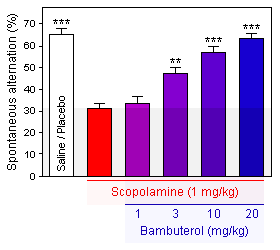
**, p≤0.01, ***p≤0.001, vs scopolamine + placebo (red column).
-
The graph illustrates mice’s cognitive performance measured through spontaneous alternation in the T-maze, a widely used test for assessing rodent cognition in a single session. In cognitively intact mice (Saline/Placebo, white column), a high rate of alternation is observed as they naturally prefer to explore a novel arm over one recently visited. Administration of 1 mg/kg scopolamine induces a cognitive deficit, reducing alternation to levels below 50%. This indicates the emergence of stereotypy (repetitive behavior) and thus cognitive deficit (red column).